

D5. Inertia tensor
[math]\displaystyle{ \newcommand{\uvec}{\overline{\textbf{u}}} \newcommand{\vvec}{\overline{\textbf{v}}} \newcommand{\evec}{\overline{\textbf{e}}} \newcommand{\Omegavec}{\overline{\mathbf{\Omega}}} \newcommand{\velang}[2]{\Omegavec^{\textrm{#1}}_{\textrm{#2}}} \newcommand{\Alfavec}{\overline{\mathbf{\alpha}}} \newcommand{\accang}[2]{\Alfavec^{\textrm{#1}}_{\textrm{#2}}} \newcommand{\ds}{\textrm{d}} \newcommand{\ps}{\textrm{p}} \newcommand{\hs}{\textrm{h}} \newcommand{\Ns}{\textrm{N}} \newcommand{\Fs}{\textrm{F}} \newcommand{\ms}{\textrm{m}} \newcommand{\ts}{\textrm{t}} \newcommand{\us}{\textrm{u}} \newcommand{\vs}{\textrm{v}} \newcommand{\Rs}{\textrm{R}} \newcommand{\Ts}{\textrm{T}} \newcommand{\Ls}{\textrm{L}} \newcommand{\Bs}{\textrm{B}} \newcommand{\es}{\textrm{e}} \newcommand{\fs}{\textrm{f}} \newcommand{\is}{\textrm{i}} \newcommand{\Is}{\textrm{I}} \newcommand{\ks}{\textrm{k}} \newcommand{\js}{\textrm{j}} \newcommand{\rs}{\textrm{r}} \newcommand{\ss}{\textrm{s}} \newcommand{\Os}{\textbf{O}} \newcommand{\Gs}{\textbf{G}} \newcommand{\Cbf}{\textbf{C}} \newcommand{\Or}{\Os_\Rs} \newcommand{\Qs}{\textbf{Q}} \newcommand{\Cs}{\textbf{C}} \newcommand{\Ps}{\textbf{P}} \newcommand{\Ss}{\textbf{S}} \newcommand{\P}{\textrm{P}} \newcommand{\Q}{\textrm{Q}} \newcommand{\deg}{^\textsf{o}} \newcommand{\xs}{\textsf{x}} \newcommand{\ys}{\textsf{y}} \newcommand{\zs}{\textsf{z}} \newcommand{\dert}[2]{\left.\frac{\ds{#1}}{\ds\ts}\right]_{\textrm{#2}}} \newcommand{\ddert}[2]{\left.\frac{\ds^2{#1}}{\ds\ts^2}\right]_{\textrm{#2}}} \newcommand{\vec}[1]{\overline{#1}} \newcommand{\vecbf}[1]{\overline{\textbf{#1}}} \newcommand{\vecdot}[1]{\overline{\dot{#1}}} \newcommand{\OQvec}{\vec{\Os\Qs}} \newcommand{\QPvec}{\vec{\Qs\Ps}} \newcommand{\OPvec}{\vec{\Os\textbf{P}}} \newcommand{\OCvec}{\vec{\Os\Cs}} \newcommand{\OGvec}{\vec{\Os\Gs}} \newcommand{\abs}[1]{\left|{#1}\right|} \newcommand{\braq}[2]{\left\{{#1}\right\}_{\textrm{#2}}} \newcommand{\matriz}[9]{ \begin{bmatrix} {#1} & {#2} & {#3}\\ {#4} & {#5} & {#6}\\ {#7} & {#8} & {#9} \end{bmatrix}} \newcommand{\vector}[3]{ \begin{Bmatrix} {#1}\\ {#2}\\ {#3} \end{Bmatrix}} \newcommand{\vecdosd}[2]{ \begin{Bmatrix} {#1}\\ {#2} \end{Bmatrix}} \newcommand{\vel}[2]{\vvec_{\textrm{#2}} (\textbf{#1})} \newcommand{\acc}[2]{\vecbf{a}_{\textrm{#2}} (\textbf{#1})} \newcommand{\accs}[2]{\vecbf{a}_{\textrm{#2}}^{\textrm{s}} (\textbf{#1})} \newcommand{\accn}[2]{\vecbf{a}_{\textrm{#2}}^{\textrm{n}} (\textbf{#1})} \newcommand{\velo}[1]{\vvec_{\textrm{#1}}} \newcommand{\accso}[1]{\vecbf{a}_{\textrm{#1}}^{\textrm{s}}} \newcommand{\accno}[1]{\vecbf{a}_{\textrm{#1}}^{\textrm{n}}} \newcommand{\re}[2]{\Re_{\textrm{#2}}(\textbf{#1})} \newcommand{\psio}{\dot{\psi}_0} \newcommand{\Pll}{\textbf{P}_\textrm{lliure}} \newcommand{\agal}[1]{\vecbf{a}_{\textrm{Gal}} (#1)} \newcommand{\angal}[1]{\vecbf{a}_{\textrm{NGal}} (#1)} \newcommand{\vgal}[1]{\vecbf{v}_{\textrm{Gal}} (#1)} \newcommand{\fvec}[2]{\overline{\mathbf{F}}_{\textrm{#1}\rightarrow\textrm{#2}}} \newcommand{\mvec}[2]{\overline{\mathbf{M}}_{\textrm{#1}\rightarrow\textrm{#2}}} }[/math]
The Vector Theorems relate the external interaction torsor on a system ([math]\displaystyle{ \sum\overline{\mathbf{F}}_\mathrm{ext} }[/math], [math]\displaystyle{ \sum\overline{\mathbf{M}}_\mathrm{ext}(\Qs) }[/math]) to the change in time of vectors that depend on how the mass is distributed in the system (mass geometry) and on its motion. In the LMT, this vector is the linear momentum of the system, while in the AMT it its angular momentum (or kinetic momentum). This unit provides the tools necessary to describe the mass geometry of a rigid body and to calculate these two vectors.
D5.1 Centre of masses
The centre of mass of a mechanical system is a point whose kinematics is a weighted kinematics of all the elements of the system that have mass. In this course it is represented by the letter G.
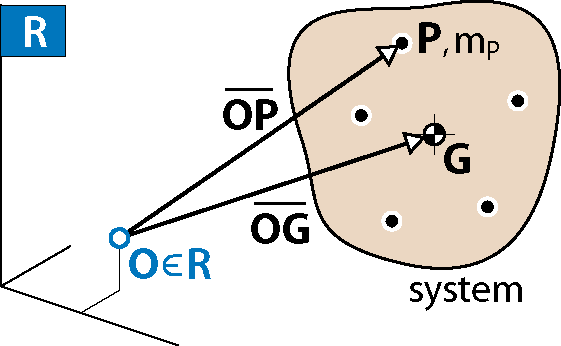
In a homogeneous rigid body S, the location of G is easy when the rigid body has important symmetries (Figure D5.2).

When this is not the case, integration must be carried out to obtain it. If M is the total mass of the rigid body:
[math]\displaystyle{ \overline{\Os_\Rs\Gs}=\frac{1}{\mathrm{M}} \int_\mathrm{S}\mathrm{dm}(\Ps)\overline{\Os_\Rs\Ps} }[/math]
The Table shows the centre of mass of the most common geometries. From this information and for rigid bodies S formed by several of these elements [math]\displaystyle{ \mathrm{S}_\is }[/math], the position of the centre of mass can be found as a weighted average of the position of each [math]\displaystyle{ \mathrm{G}_\is }[/math].
✏️ Example D5.1: shell
|
|
The rigid body S is made up of a cylindrical shell and a spherical semi-shell, both homogeneous and with the same surface density [math]\displaystyle{ \sigma }[/math].
For symmetry reasons, the [math]\displaystyle{ (\xs,\ys) }[/math] coordinates of the centre of mass G are zero: [math]\displaystyle{ (\xs_\mathrm{G},\ys_\mathrm{G})=(0,0) }[/math]. The z coordinate of the cylindrical shell is [math]\displaystyle{ \zs_\mathrm{Gcil}=\Rs/2 }[/math]. That of the spherical semi-shell can be found from the Table: |

- [math]\displaystyle{ \zs_\mathrm{Gsph}=\Rs+(\Rs/2)=3\Rs/2 }[/math].
- The mass of each element is the product of the surface density by the surface area of the element:
- [math]\displaystyle{ \ms_\mathrm{cyl}=\sigma 2 \pi \Rs^2 }[/math] , [math]\displaystyle{ \ms_\mathrm{sph}=\sigma \frac{1}{2} 4 \pi \Rs^2= \sigma 2 \pi \Rs^2 }[/math]
.
Hence: [math]\displaystyle{ \zs_\mathrm{G}=\frac{\ms_\mathrm{sph}\zs_\mathrm{Gsph}+\ms_\mathrm{cyl}\zs_\mathrm{Gcyl}}{\ms_\mathrm{sph}+\ms_\mathrm{cyl}}=\frac{2\pi\Rs^2(3/2)\Rs +2\pi\Rs^2(1/2)\Rs}{2\pi\Rs^2+2\pi\Rs^2}=\Rs }[/math]
✏️ Example D5.2: folded plate
|
|
The rigid body S is a folded homogeneous triangular plate with a surface density of [math]\displaystyle{ \sigma }[/math].
The centre of mass can be found as the weighted average of the centre of mass of a square plate with a side length of 6L and two triangular plates with legs 6L: |


- [math]\displaystyle{ (\xs_1,\ys_1)=(3\Ls,3\Ls) \hspace{3cm} (\xs_2,\ys_2)=(8\Ls,2\Ls) \hspace{3cm} (\xs_3,\ys_3)=(2\Ls,4\Ls) }[/math]
- [math]\displaystyle{ \hspace{1cm} \ms_1=(6\Ls)(6\Ls)\sigma=36\Ls^2\sigma \hspace{1.5cm} \ms_2=(1/2)(6\Ls)(6\Ls)\sigma=18\Ls^2\sigma \hspace{1cm} \ms_3=(1/2)(6\Ls)(6\Ls)\sigma=18 \Ls ^2 \sigma }[/math]
- Therefore: [math]\displaystyle{ (\xs_\mathrm{G},\ys_\mathrm{G})=\frac{36\sigma(3,3)\Ls^3+ 18\sigma (8,2)\Ls^3 + 18\sigma (2,4)\Ls^3}{36\Ls^2\sigma+18\Ls^2\sigma+ 18 \Ls^2 \sigma}=(4,3)\Ls. }[/math]
✏️ Example D5.3: cylinder with a hole
|
|
The rigid body is a homogeneous perforated cylinder of density [math]\displaystyle{ \rho }[/math], and can be considered as a superposition of a rigid cylinder, with height 4L and radius 2r, and a cylinder of negative mass, with height 2L and radius r.
For symmetry reasons, [math]\displaystyle{ (\xs_\mathrm{G},\ys_\mathrm{G})=(0,0) }[/math]. The z coordinate can be found as a weighted average of the z coordinates of two cylinders: Mass of the rigid cylinder and mass of the hole: |

- [math]\displaystyle{ \ms_\mathrm{rigid}=\mathrm{V}_\mathrm{rigid}\rho=\pi(2\rs)^24\Ls\rho=16\pi\Ls \rs^2\rho \quad , \quad \ms_\mathrm{hole}=\mathrm{V}_\mathrm{hole} \rho=\pi\rs^22 \Ls\ \rho=2\pi\Ls \rs^2\rho }[/math]
- [math]\displaystyle{ \zs_\mathrm{G}=\frac{\ms_\mathrm{rigid}\zs_\mathrm{rigid}- \ms_ \mathrm{hole} \zs_\mathrm{hole}}{\ms_\mathrm{mrigid} -\ms_\mathrm{hole}}= \frac{16\pi\Ls\rs^2\rho \cdot 2\Ls - 2\pi\Ls \rs^2 \rho \cdot 3\Ls}{16\pi\Ls\rs^2\rho-2\pi\Ls\rs^2\rho}=\frac{13}{7}\Ls. }[/math]
D5.2 Inertia tensor
The calculation of the angular momentum of a rigid body S at a point Q of that rigid body can be done easily from a positive definite symmetric matrix [math]\displaystyle{ \mathrm{II}(\Qs) }[/math], called the inertia tensor of S at point Q, and its angular velocity [math]\displaystyle{ \velang{S}{RTQ} }[/math] (which is equal to [math]\displaystyle{ \velang{S}{Gal} }[/math] since the reference frame RTQ has a translational motion relative to a Galilean one):
[math]\displaystyle{ \overline{\mathbf{H}}_{\text {RTQ }}(\mathbf{Q})=\int_{\mathrm{s}} \overline{\mathbf{Q P}} \times \mathrm{dm}(\mathbf{P}) \overline{\mathbf{v}}_{\text {RTQ }}(\mathbf{P}) \equiv \mathrm{II}(\mathbf{Q}) \bar{\Omega}_{\text {RTQ }}^{\mathrm{s}}=\mathrm{II}(\mathbf{Q}) \bar{\Omega}_{\text {Gal }}^{\mathrm{s}} . }[/math]
The relationship between angular momentum [math]\displaystyle{ \overline{\mathbf{H}}_\mathrm{RTQ}(\Qs) }[/math] and angular velocity [math]\displaystyle{ \velang{S}{Gal} }[/math] is not a simple proportionality, since [math]\displaystyle{ \mathrm{II}(\Qs) }[/math] is a matrix. For that reason, these two vectors are not parallel in general (Figure D5.3).

The [math]\displaystyle{ \mathrm{II}(\Qs) }[/math] elements in a vector basis B (with axes 123) have to do with the mass distribution of S around some coordinate axes [math]\displaystyle{ (\xs_1,\xs_2,\xs_3) }[/math] with origin in Q (Figure D5.4):
|
|
[math]\displaystyle{ I_{ii} = \sum_S [x_j^2(\Ps)+x_k^2(\Ps)]dm(\Ps) = \sum_S \delta_i^2(\Ps) dm(\Ps) \geq 0 }[/math] [math]\displaystyle{ (\delta_i(\Ps) = \text{distance from } (\Ps) \text{to axis i}) }[/math] [math]\displaystyle{ I_{ij} = I_{ji} = - \sum_S x_i(\Ps)x_j(\Ps)dm(\Ps), \text{ either sign} }[/math] |


The elements on the diagonal ([math]\displaystyle{ \mathrm{I}_\mathrm{ii} }[/math]) are called moments of inertia, and can never be negative. Those outside the diagonal ([math]\displaystyle{ \mathrm{I}_\mathrm{ii} }[/math]) are the products of inertia, and can have either sign.
If the B vector basis has a constant orientation relative to S, the [math]\displaystyle{ \mathrm{I}_\mathrm{ii} }[/math] elements are constant. In this course, we always work with inertia tensors with constant elements.
D5.3 Some relevant properties of the inertia tensor
D5.4 Steiner’s Theorem
D5.5 Change of vector basis
© Universitat Politècnica de Catalunya. All rights reserved